Mike Byrnes shares why artificial intelligence is creating real, near-term challenges for business leaders.
 CEOs and almost all business leaders are waking up to a new reality: they now need to be artificial intelligence experts. Those aware of the AI trends and capabilities are beginning to see how these monumental advancements will impact almost every business. Areas such as marketing, operations, and compliance are being turned upside down on their heads.
The businesses that position themselves to be at the forefront of positive changes, will have a huge competitive advantage versus slower-reacting competitors. With these advancements, there are some real challenges for CEOs. Here are a handful of things business executives and owners need to prepare for:
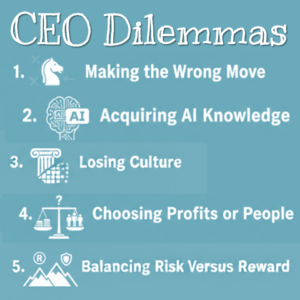
- Making the Wrong Move
With advancements coming from all angles, even the most modern companies will have limits in how many projects they can take on at once. IT resources will get spread too thin to take on all major initiatives at once. CEOs will be in a difficult position of determining which AI programs to implement first.
Making the wrong decision can be costly, as there can be steep investments that might lead to no positive advancements. On top of that risk, ‘opportunities lost’ might be an even bigger issue. If a competitor advances faster, where does that lead the CEO who has fallen behind?
Many helpful AI companies will pop up with AI agents, pilots and tools to make meaningful business improvements, but if the tech stack is not properly orchestrated, it can bog down the advancements and even the entire infrastructure.
Guidance:
CEOs cannot afford to chase every AI solution. They need to be careful to not guess which AI initiative to implement or they will stall out their business advancement. They need to create a well strategized AI prioritization framework tied directly to business outcomes. Pilot programs can help test and learn, then when more and more helpful solutions are added, a key focus will be orchestration of the AI tech stack, ensuring integrations are intentional rather than fragmented. Organizations that can achieve this, will be ultra competitive.
- Acquiring AI Knowledge
Everyone is learning and will continue to need to do so at an accelerated pace. The first to figure out an effective AI-adoption strategy undoubtably will have more business success. Each year, more and more advancements will take shape. Because of fast moving innovation, CEOs will now need to be tech experts, even if that was not their strength. How will they learn a new skillset, when many are already overworked?
The larger businesses will depend on having the right AI-focused professionals in-house to be able to better take advantage of progress. However, there will be a scarcity of these professionals. Companies will be in true recruiting wars to bring in the best talent, although that will be costly. The other option is to grow talent in-house, but that takes time and companies can make mistakes and fall behind.
With a talent shortage, the more that is needed to be outsourced, the more costs increase. Plus, if the same third-party services are available to all the competition, it is hard to get a true competitive advantage.
Many CEOs have already started to gamble on AI. Increased spending leads to increased pressure to deliver better business results.
Guidance:
CEOs likely cannot become AI scientists, so instead they need to become leaders who can understand all the AI capabilities, limitations, and implications for the business, while also managing a team of internal and external talent to stay ahead of the rapid change. If faced with a talent shortage, training for the future should be a critical priority. The less dependencies on third parties, the more of a competitive advantage a firm will have.
- Losing Culture
Many business leaders pride themselves on creating an employee-friendly culture. In doing so, they have happier associates who in turn work harder, are more driven, and less likely to leave. The issue AI will create is that it will replace jobs. In the beginning, maybe it just augments employees’ work, but over time jobs will definitely be lost. With every layoff, employee morale can be devastated. Those left with jobs will be wondering, “Am I next?!”
Entry-level positions and other operational types of roles are likely the first to go, but not many humans will be safe. The price of knowledge will drop near zero, so those higher-salaried roles will also eventually be replaced by AI. The educated and experienced ‘higher ups’ might find they have targets on their backs.
It is not just desk jobs that will be lost. Advancements in robotics are soon to impact manual labor. As the humanoid robots will be utilizing AI, even skilled professionals will be at risk of losing their jobs.
Humans will need to pivot and careers will have to be redefined. Nobody likes change, further eroding the culture.
Guidance:
CEOs will need to be transparent and supportive about how AI will become a part of a company’s long-term success. The more they can communicate, the more the employees will trust the leadership, even if it is negative news being shared. Culture is going to take a hit no matter what, but that will be consistent across most companies. If CEOs can show they genuinely care about their employees, and make efforts to have retraining programs and new career paths to have human partner with AI, some of the positive culture can be preserved.
- Choosing Profits or People
Leadership will need to decide between cost-cutting initiatives versus keeping humans employed. For example, imagine a $40,000 robot can do all the work of one human, but that human gets paid $100,000. Oh, and that robot can work 23 hours instead of much shorter daily shifts by people, who also take breaks, go on vacation and have sick days.
What if AI can replace a workforce for a fraction of the costs? Most CEOs do not want to conduct mass layoffs, but their mandates are to deliver profits for their shareholders. In a capitalist society, we push for higher and higher profits. If executives make decisions to protect humans, will boards have them replaced?
CEO compensation continues to skyrocket relative to non-leadership roles. How will CEOs feel about receiving record incentives while the jobless rate soars?
Guidance:
CEOs of ‘for-profits’ are tasked with maximizing shareholder returns, but they will have to balance a delicate tightrope. They need to get out ahead of the employment issue, retrain, and transition employees to best lead their workforce. Associates will need to be redeployed to higher value positions that require human oversight and judgment.
- Balancing Risk Versus Reward
With every use of AI, there will be a new technological risk. For example, can customer data be more easily hacked and stolen when utilizing artificial intelligence? What intellectual property might be stolen? What protections are needed?
Side note: There will be more ‘deep fakes’ of CEOs or executives, in which bad actors, using AI, pretend to send messages, adding to business risks.
With the rise of “agentic AI” (where an artificial intelligence system can accomplish specific duties with limited or no supervision), does human non-involvement endanger the business?
How can costly mistakes be avoided? For example, is it possible that AI makes bad recommendations that lead to CEOs making the wrong decisions?
With lower and lower ‘hallucination’ rates, AI is making fewer mistakes. At some point, do humans make more mistakes than AI? If AI is doing more and more, what person or department is responsible for it?
With an advanced AI dependency, expertise and solutions will likely need to be outsourced, creating increasing reliance on third parties.
CEOs will need to determine what is the right in-house oversight. AI governance will be critical to determine who is responsible and how people and companies will be held accountable, especially as more and more is done in a ‘black box.’
Regulations will increase and become more and more complicated. They also run the risk of being fragmented, further complicating the risk considerations.
Guidance:
Clear accountability for AI decisions starts with creating a governance structure that will oversee all major initiatives and assign ownership. A well-thought-out strategy for third-party partnerships and AI risk management are key priorities.
Final Advice
CEOs will have many challenges ahead. If they stick to more of the same, they undoubtably fall behind. As the AI frontier expands, there are going to be many dilemmas for business leadership to face to best succeed.
Facing Dilemmas?
Contact Byrnes Consulting or subscribe to Business Bests for helpful advice as we all are forced to evolve in this new AI world.
Note from Mike: For the first time in over 500 articles, an editor of a publication used AI and completely rewrote my article without my approval. It is a scary trend that will eventually eliminate the authentic human voice that we each have. These Byrnes Consulting website posts are usually teasers to get visits to my published articles, but this time I have uploaded my original content in its complete form. If you want to read the AI version, here is a link to what is published on The CEO Magazine.